

On this page...
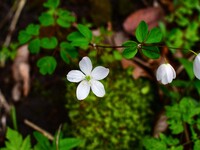
Wildflowers are enticing treasures for wilderness lovers each spring.
Just like the weather, wildflowers can be unpredictable. Get an up-to-date list of woodland wildflowers in bloom in your inbox.
Iowa’s woodlands come to life with patches of color in early spring as native wildflowers start to bloom. Looking for wildflowers can be a fun, unique spring activity for kids and is a great way to spend time outdoors as a family.
| Report Date | Area | Description of Woodland Wildflower Blooms |
|---|---|---|
| 4/27/2026 | Northern Iowa | Look for wild ginger, bluebells and Jack-in-the-pulpit at the Tosanak Recreation Area in Floyd County. Find red trillium and bellwort at the Riverbend Wildlife Area.
Virginia bluebells are really popping at George Wyth State Park. Find blue and yellow violets, white phlox, wild ginger, buttercups, false rue anemone, spring beauty, and garlic mustard.
White trout lily and Dutchman’s breeches are on their way out, very few blooms are intact in Emmet County. Violets and large-flowered bellwort are prevalent. Blue phlox and cut-leaved toothwort are blooming. |
| 4/25/2026 | Central Iowa | Trout lily is blooming in Sac County. Columbine is budding. Jacob's ladder and Solomon seal are emerging.
Spring beauty, garlic mustard, bush honeysuckle, and Ohio buckeye are blooming in Guthrie County. Look for fragrant bedstraw and Solomon’s seal foliage.
Find violet wood sorrel and white trillium in Jackson County. |
| 4/27/2026 | Southern Iowa | Ephemeral wildflowers are plentiful this week in Appanoose County, Lucas County, Mahaska County, Marion County, Monroe County and Wayne County. Geranium, buttercup, Bishop’s cap, bellwort, woodland phlox, ginger, hepatica, spring beauty, toothwort, rue anemone, woodland violets, and pussytoes are flowering.
Woodland wildflowers are still going strong in Des Moines County and Henry County. Virginia bluebells are virtually done for the season. Spring beauty is still strong, but also past its peak. Woodland blue phlox are still abundant; look for the white variety. Common blue violets and Confederate violets, while still easy to find, are also diminishing. Garlic mustard is diminishing. Swamp buttercups are easy to find in the wetter areas. Small-flowered buttercups are still numerous. You can still find Jacob’s ladder and prairie trillium, but they will be gone very soon. Wild ginger is abundant. Wild geranium is peaking.
New bloomers in the woodlands this week are mayapple, spreading chervil, aniseroot, Jack-in-the-pulpit, common chickweed, and catchweed bedstraw. Green dragon and Virginia waterleaf are fully leafed out. Smooth Solomon seal are just starting to bud. Open field wildflowers are starting to come into their own with dandelions peaking, Ground ivy is still strong. Shepard’s purse is abundant, Prairie ragwort, thyme-leaved speedwell, and yellow rocket are beginning to bloom.
Leaves are up for Jack-in-the-pulpit and cat mint in Appanoose County. Sweet cicely, mayapple, and Solomon's seal have buds on them. Bellwort, wild ginger, spring beauty, yellow and purple violets, woodland phlox, and trout lily are blooming. Many of the early ephemerals are fading. Virginia bluebells, tooth wort, Dutchman’s breeches, bloodroot and toothwort are done flowering for the season. |
| 4/27/206 | Western Iowa | Trout lily, Dutchman’s breeches, Jacob’s ladder, woodland phlox, bellwort, bluebells, and wild ginger are blooming at Martin’s Access in Cherokee County. Look for buds on Virginia waterleaf. |
Which wildflowers will you discover this week?
One of the most encouraging signs of spring, the first wildflowers seem to bloom overnight. Get outside this spring and see what you can find!
Early spring wildflowers are commonly called ephemerals, which means “short-lived.” They utilize a short time window when sunlight bathes the forest floor before tree leaves emerge to shade them out. It's a smart ecological adaptation and pretty, too.
Wildflowers can be found by simply walking, or biking along trails, on a hike through a local or Iowa state park or just driving slowly along a county road. It's illegal to pick wildflowers in public conservation areas, so take a photo or sketch your finds and leave the plants untouched.
Spotting secretive wildflowers is a refreshing, unique spring activity for the whole family. Get outside this spring and see what you can find. Please take only pictures and leave the flowers for others to enjoy!
Common Spring Wildflowers
Wildflowers come in countless varieties and yet can be so fleeting. They sprinkle wild landscapes with color and send subtle fragrances into the nearby air.
Look for these common Iowa spring wildflowers.
- Bloodroot
- Common blue violet
- Dutchman’s breeches
- Jack-in-the-pulpit
- Rue anemone
- Shooting star
- Snow trillium
- Speckled Phlox (wild sweet William)
- Spring beauty
- Virginia bluebells
- White trout lily
- Wild columbine
- Wild geranium

Come Create Unforgettable Memories!
Sign your kids up for a fun five-day immersive adventure they will never forget. Campers will explore some of the most amazing places in Iowa and build outdoor skills that can last a lifetime.
Helpful Resources
Ready to increase your wildflower activities and knowledge? These resources can help!
Wildflower Books & Guides
- Wildflowers of Iowa Woodlands by Sylvan Runkel and Alvin Bull
- Iowa Trees & Wildflowers: A Folding Pocket Guide to Familiar Plants by James Kavanagh
- Wildflowers of the Midwest: Your Way to Easily Identify Wildflowers by Stan Tekiela
- A Peterson Field Guide To Wildflowers: Northeastern and North-central North America by Margaret McKenny and Roger Tory Peterson
- Wildflowers of the Midwest: A Field Guide to Over 600 Wildflowers in the Region by Don Kurz
- Wildflowers of Southeastern Iowa -Volume 1 Spring by Don Weiss
Online Resources
- Celebrating Wildflowers - Just for Kids(U.S. Forest Service)
- Native Woodland Flowers for the Home Garden (ISU Extension)
- Iowa’s Spring Wildflowers (Iowa Association of Naturalists)
- Wildflowers of the United States Database
- Iowa Native Plant Society
- Native Plants Database (Iowa Living Roadway Trust Fund)
- Nature BINGO (545.18 KB) .pdf
Fun Family Outdoor Activities
- A Poem's Hunt (632.07 KB) .pdf
- Animal Signs Hike (624.67 KB) .pdf
- Birding Guide in Iowa (5.68 MB) .pdf
- Create Your Own Nature Journal (2.38 MB) .pdf
- Habitat Scavenger Hunt (796.13 KB) .pdf
- Look for Nature Hunt (1.64 MB) .pdf

These quick drying mesh bags fit easily in your kayak hatch, bike bag, picnic basket, tacklebox, car trunk or backpack.
You can pick up two litter bags at sites across Iowa.
Tick Safety & Protection
- More than a dozen tick species are found in Iowa, but three are most common: Blacklegged (deer tick), dog tick (wood tick), and the lone star tick. Ticks are active March through November in Iowa.
- Prevention is best. Protect yourself from ticks by:
- Wearing long-sleeve shirts and long pants tucked into socks
- Wearing light colored clothes, which makes finding ticks easier.
- Using repellent containing DEET
- Adding permethrin repellents on clothing per label
- Checking for ticks while you're out and once you're home
How to Remove Ticks
- If you find yourself outdoors without tweezers and need to remove a tick:
- Use fine weight fishing line, thread or floss tied into a simple overhand knot.
- Gently tighten the knot around the head of the tick.
- Slowly pull the ends of the line to tighten the knot and pull out the tick.
- Always check your body and hair after spending time outdoors and remove ticks as soon as possible.